

Plantation shutters.
Wide louvers in a framed panel, scribed into the opening and finished like the rest of the millwork. The treatment people notice least and keep longest.
The one that stays with the house.
A plantation shutter is a frame, a set of stiles and rails, and a run of wide louvers on a tilt. It is made like a piece of cabinetry and installed like one: packed, leveled, and scribed to plaster that is never quite straight.
Which is why it behaves differently from everything else we sell. It does not get taken down when the room changes, and it is usually still there when the house is sold. We measure and fit them in homes from Delray Beach to Boca Raton and across Palm Beach County.


What you choose.
The biggest visual decision on the page. Narrower louvers read traditional and close down tighter; wider ones mean fewer slats across the glass and a much clearer view when open.
Hardwood takes paint and stain beautifully and stays lightest on a tall panel. Engineered cores are more stable across a wide span. Waterproof composite is what goes anywhere near a bath, a shower, or a pool room.
On a plantation shutter the louvers are wide, so a center rod draws a strong vertical line across a lot of glass. A hidden tilt moves them from the edge of the panel and leaves the louvers clean, which suits a wide louver especially well.
How the opening is divided, which way the panels swing, and whether a mid rail lets the top and bottom tilt independently. On a wide opening, bi-fold or a track keeps the glass clear.
An L-frame sits on the face, a Z-frame returns into the reveal, and both are scribed to the plaster. Painted to a standard white or matched to the trim you already have.
Rooms a plantation shutter is right for.
Architecture, not decoration
A framed panel in the reveal reads as part of the building. In a room with good trim it finishes the window rather than covering it.
Humidity it can take
In waterproof composite a shutter will sit over a bath for years without cupping, which no wood treatment can promise.
Privacy at eye level
Tilt the louvers up and you keep the daylight and the sky while losing the sightline from the sidewalk entirely.
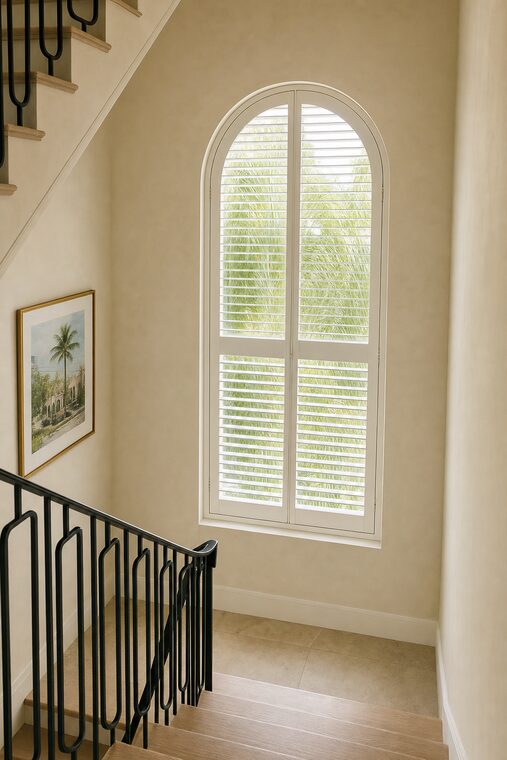
An arch is where a shutter beats everything else.
Because the frame is custom rather than off the shelf, it can be cut to any shape the opening actually is. Arches, angles, gable ends, and circles all take shutters, and none of them take a rectangular shade.
We take a physical template off the opening and the shutter is made to it, so a segmental arch or a slightly irregular angle is matched as it really is.
About unique window shapesPlantation shutters, answered.
Which louver size should I pick? +
3 1/2 inch is right on most windows and is what we recommend unless there is a reason not to. Go narrower on a small or period window, wider on a tall opening with the headroom to stack it.
Will they go dark enough for a bedroom? +
No, and no shutter will. A wide louver closes well against its neighbor, but light still finds the edges of the panel and the hinge side. Where a bedroom has to be truly dark and the reveal has the depth, we fit a blackout shade behind the shutter.
Can I have them in a bathroom? +
Yes, in waterproof composite, which reads much the same as painted hardwood from across the room. It is what we specify over a tub, beside a shower, or in a pool room, where hardwood would eventually take on moisture and warp.
What if my opening is not square? +
Almost none of them are, and a shutter shows it more than anything else because the panel is rigid. The installer packs the frame level and scribes it to the wall, so the panels swing true and close evenly even when the opening does not.
Do they add value to the house? +
We cannot promise a number. What we can say is that plantation shutters usually stay with the house when it sells, and buyers tend to see them as part of the trim rather than as something the seller will take.
Plantation shutters, fitted.
The same treatment across four rooms, and what changes between them.
Worth looking at alongside.

Cafe style
Lower panels only, for a street-facing kitchen or breakfast room where you want privacy at the table.
See the range →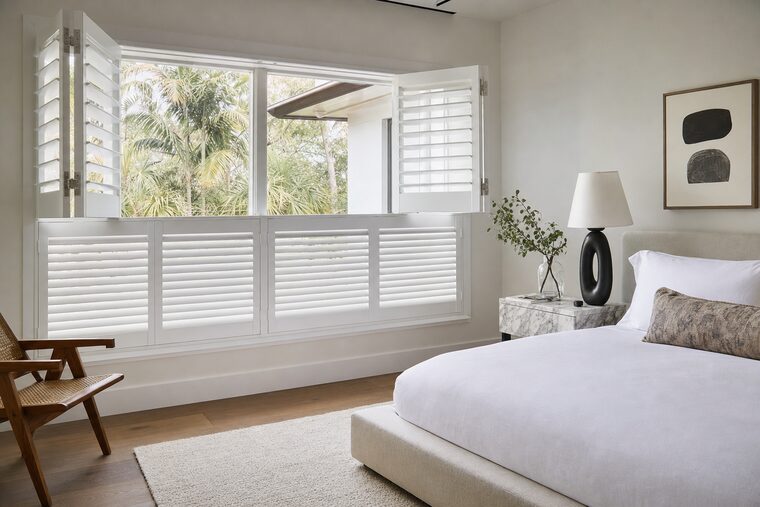
Tier on tier
Two independent sets stacked, so the top and the bottom work separately.
See the range →
Shaped openings
Arches, angles, and circles, cut to the shape rather than boxed across it.
See the range →Let's design your tomorrow.
Book a free in-home consultation. We will bring the samples, take the measurements, and leave you with a proper quote.