A shade goes up or down. Blinds tilt, which is the only way to keep the daylight and lose the glare at the same time.
Every other treatment gives you one axis. A shade is up or down; drapery is open or closed. Blinds are the only thing on a window that lets you keep the opening completely clear and still aim the light at the ceiling instead of the television.
That matters most on a west wall at four in the afternoon, and in any room where you want to see out at eye level and block the sun above it.

Wide flat panels that slide past each other on a ceiling track. A cleaner, more contemporary answer to a very wide opening.
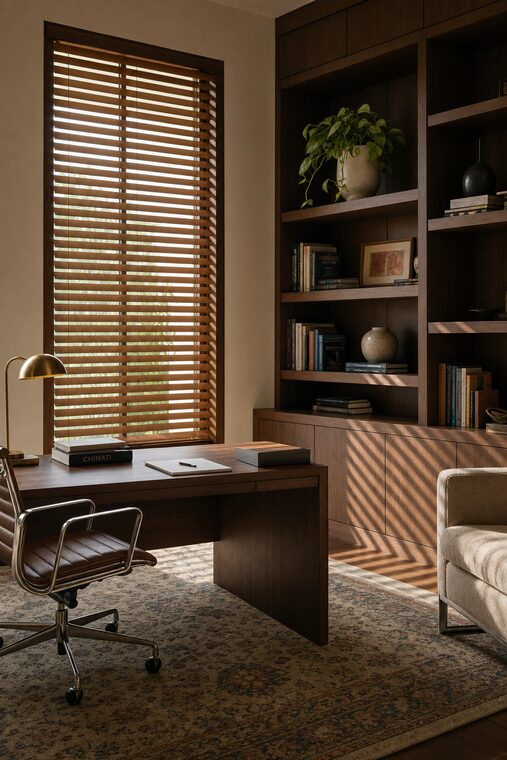
Real hardwood, stained or painted. The warmest of the six and the lightest in the hand, which matters on a wide window.
See the range →
The look of painted timber without the movement. Goes where real wood should not: bathrooms, laundries, anything over a sink.
See the range →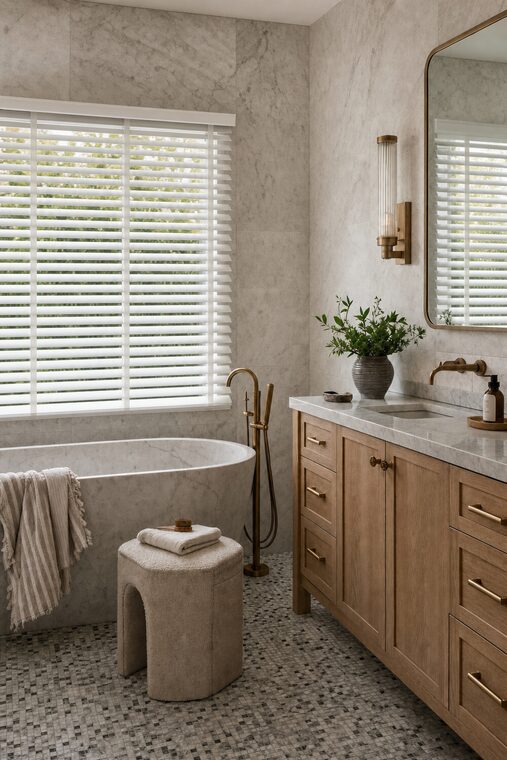
A timber core in a moisture-proof skin. Heavier than faux wood, and the one that stays flat on a tall drop in Florida humidity.

Slim, precise, and available in slat widths down to half an inch. The choice for a study, an office, or anywhere the architecture is the point.
See the range →
Vanes that tilt and stack sideways. Still the most practical answer on a slider you actually walk through every day.
Wider slats mean fewer of them, a clearer view when open, and a more contemporary look. Narrow slats close down tighter and suit a small window or a period room.
This is a moisture question before it is a looks question. Real wood warps over a shower or a sink; faux wood and composite do not. We will not specify timber where it will not last.
Blinds close to a line, not to black. Slats overlap but the route cords leave small holes and the edges leave a gap. Where a room has to go properly dark, a blind wants a shade behind it.
Tilt and lift are two separate actions, and on a wide or high window both are worth motorizing. Cordless is standard in any room a child uses.
Inside the recess shows the trim and the architecture. Outside it covers a bad frame, blocks more light at the edges, and makes a small window read larger. We decide this at the measure.
The single decision that changes the character of a blind more than the color does. A designer brings samples in each width so you can see them against your own window.
Aluminum only. Tight, technical, and almost invisible when open. Right in a study, a utility room, or a small period window where a wide slat would overwhelm the opening.
The everyday width and the one most people picture. Enough stack to look substantial, enough slats to close down tightly. Safe on almost any window in the house.
Our usual recommendation on a main living window. Noticeably fewer slats across the glass, which means a clearer view out and a calmer look from inside.
For tall openings and double-height walls. The proportions only work when the window is big enough to carry them, and the stack at the top is deep, so it wants headroom.
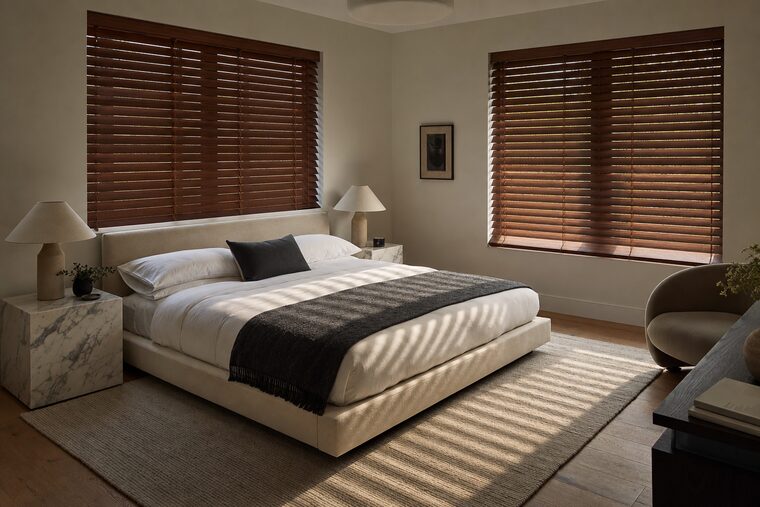
Blinds have two movements, and on a high or wide window both are a nuisance by hand. Motorized, the whole run tilts together to the same angle, which is the thing you cannot do with a wand.
Lutron is our premium motorization option for shades and drapery tracks: quiet, precise, and made to work with the rest of the home.
About motorizationOn their own, no. Slats close to a line rather than to black, and the edges always leak a little. For a bedroom we usually specify a blind for the daytime and a blackout shade behind it.
We would rather you didn't. Humidity and splashes make timber cup and twist, and no finish stops it for long. Faux wood and composite look the same from across the room and will not move.
A closed slat and a dry microfibre cloth, tilted one way then the other. Nothing wet on real wood. Aluminum and composite will take a damp cloth without complaint.
Vertical blinds or a panel track, both of which stack sideways and clear the doorway. A horizontal blind on a slider has to be lifted every time you walk through it, which nobody does twice.
There is no honest answer to that before we have measured. Price moves with material, slat width, size, and motorization. The consultation and the written quote are both free.
Every one of these was measured to its opening and specified for the room it is in, not for the one next door.
Four steps, one team, and no surprises at the end of it.
A short conversation about the windows, the light, and how you actually use the space.
A designer visits, measures every opening precisely, and brings samples to see in your own light.
Material, slat width, hardware, motorization, and installation. One number, itemized.
Our own installers fit, program, and test everything, then take the packaging away.
 Choosing
Nearly every south-facing room we are called to has the same complaint attached to it.
 Fitting
Bamboo blinds are natural window coverings that can add warmth to any home.
 Design
Blinds are a type of window treatment that you can use as an alternative to curtains.
Book a free in-home consultation. We will bring the samples, take the measurements, and leave you with a proper quote.