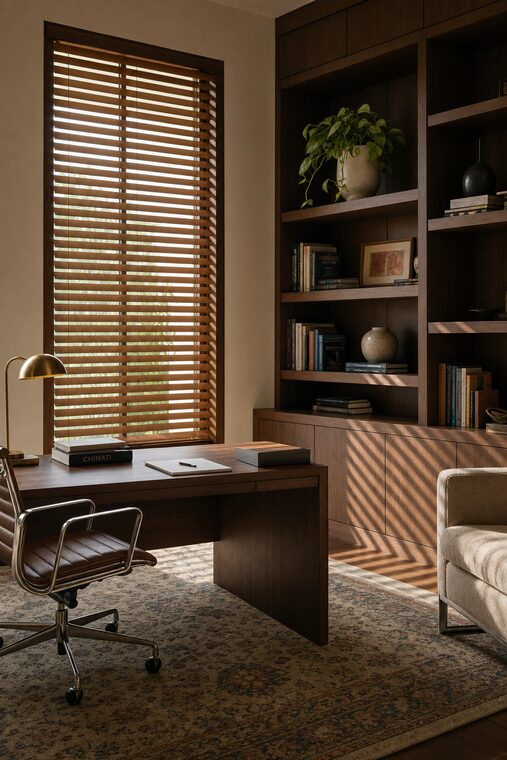
The slimmest slat we fit, in widths down to half an inch. Precise, architectural, and almost invisible when it is open.
An aluminum slat can be made far thinner than a timber one and still stay flat. That means more slats in the same drop, a tighter close, and a stack at the head so slim it nearly disappears.
It is the choice when you want the window to read as a piece of architecture rather than a piece of furniture. In a study, an office, a kitchen with dark joinery, it is the only blind that looks deliberate.


Half inch is a micro blind: very fine, almost technical, and right on a small window. One inch is the standard aluminum slat. Two inch reads closer to a timber blind in a metal finish.
Matte reads soft and absorbs light, which is what you want behind a screen. Metallic and anodized finishes catch it and suit a more industrial room. Perforated slats let a little light through when closed.
Thicker slats resist bending and keep their line over a wide span. A thin gauge on a wide window will eventually show a kink where someone has pushed it aside to look out.
A wand tilts, a cord lifts. Cordless in any room a child uses. Motorized tilt is worth it on a run of windows that should all sit at the same angle.
The slim stack means an aluminum blind fits recesses too shallow for anything else, which is often the reason it gets specified in the first place.
A matte charcoal slat tilted down kills the reflection on a monitor without darkening the room, and the fine slat looks right next to a screen.
The stack on a half inch blind is a fraction of a timber one, so it goes in reveals too shallow for a wood blind or a shade cassette.
Fully moisture-proof, wipes clean, and cheap enough that it is the sensible answer on a window nobody looks at twice.
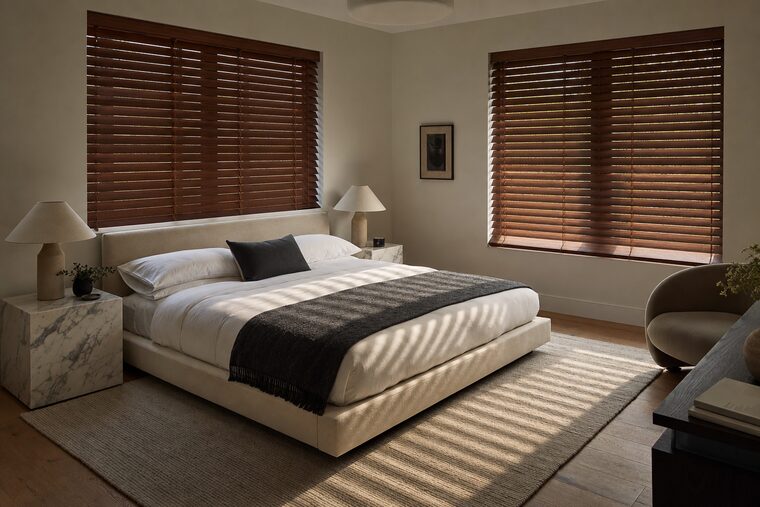
It is a question of register rather than performance. Timber is warm, softens a room, and takes a stain. Aluminum is cool, precise, and recedes.
In a bedroom or a living room, timber almost always. In a study, an office, or a kitchen with dark cabinetry, aluminum looks considered where wood would look domestic.
About wood blindsA standard gauge slat will take a kink if it is repeatedly pushed aside. On a window people lean through we specify a heavy gauge, which is noticeably stiffer.
In a draft they can rattle, more so than timber. A closed blind in a breezy room will make a sound. Where that matters we look at a shade instead.
Yes, marginally, because there are more overlaps down the drop. The bigger gain is the stack height, which is a fraction of a wider blind.
Easily. Aluminum is completely unaffected by humidity and takes a damp cloth, which makes it one of the two or three right answers for a wet room.
The slats warm up, yes, because metal conducts. On a west-facing window taking full afternoon sun, a cellular shade or a solar screen does more for the room than any blind will.
Three rooms where the blind is meant to recede.
Book a free in-home consultation. We will bring the samples, take the measurements, and leave you with a proper quote.