The look of painted timber in a material that does not care about humidity. The blind that goes where real wood should not.
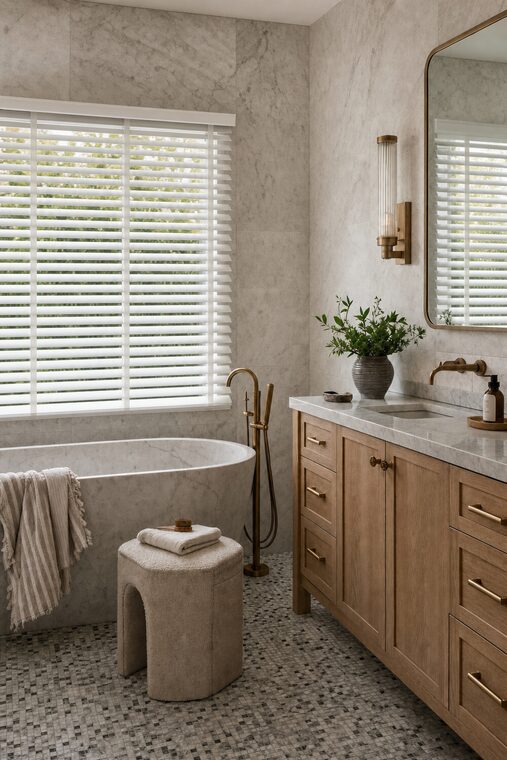
Faux wood is a PVC or composite slat molded and finished to look like painted timber. From across a room the difference is essentially invisible. What is different is what happens over a shower or a kitchen sink: nothing.
Real wood cups and twists in Florida humidity. Faux wood does not, which is why it is the specification for every wet room in the house and why it costs less at the same time.


2 inch is the everyday width. 2 1/2 inch gives fewer slats across the glass and a clearer view. Faux wood slats are heavier than timber, so on a very wide window the width affects how it lifts.
Solid PVC is the most moisture-proof and the least expensive. A composite has a timber core in a waterproof skin, which is stiffer and stays flatter across a wide span.
Painted finishes only, because the point is a uniform color rather than grain. Smooth reads more architectural; embossed has a light timber texture pressed into it.
The one real trade-off. Faux wood is heavier than basswood at the same size, so on a very wide opening we either split the run or specify a motorized lift.
Cordless as standard in any room a child uses, which includes most bathrooms. Motorized tilt where a run should sit at one angle.
The specification for any window near a bath or a shower. It will not cup, swell, or lift its finish however humid the room gets.
Splashes and steam are the two things timber cannot take. Faux wood wipes down with a damp cloth and carries on.
Where the window gets knocked, wet, and ignored, a molded slat survives what a timber one would not.
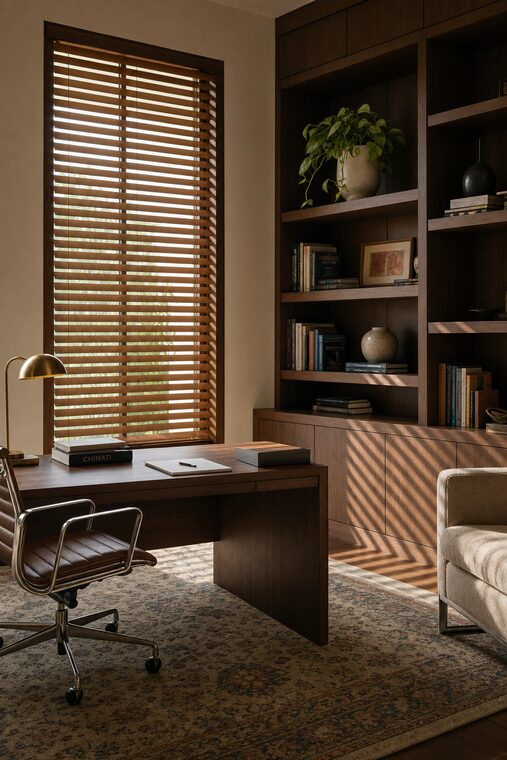
Two honest rules. Anywhere that gets wet or steamy: faux wood, every time, no exceptions. Anywhere you want a stain rather than a paint color: real timber, because molded grain never quite convinces up close.
Everywhere else it comes down to weight and budget, and both favor faux wood.
About wood blindsPainted ones, yes, to the point where nobody notices. Stained or grain-effect finishes are less convincing close up, which is why we specify real timber when you want a stain.
Yes, noticeably, and it matters on a wide window. Past a certain width we either split the run into two blinds or put a motor on the lift.
Good quality faux wood is UV stabilized and holds its color. Cheap PVC on a south-facing window does yellow, which is one of the places where the specification matters.
On the window of a wet room, yes. Directly inside a shower enclosure is asking a lot of any treatment, and we would talk about a waterproof shutter instead.
A damp cloth, which is the whole advantage over timber. Close the slats one way, wipe, close them the other way, wipe again.
Three rooms that would have destroyed a timber blind.
Real hardwood, for a stain rather than a paint color, and lighter on a wide window.
See the range →
Slimmer and fully moisture-proof too, where the look should be technical rather than warm.
See the range →
A waterproof composite shutter is the other right answer for a wet room.
See the range →Book a free in-home consultation. We will bring the samples, take the measurements, and leave you with a proper quote.