Real hardwood slats on a tilt. The warmest thing you can put on a window and the lightest in the hand on a wide one.
Basswood is light for its stiffness, which is why real timber is still the right answer on a wide window. A hardwood blind of the same size as a faux wood one is noticeably lighter to lift and puts less strain on the mechanism over the years.
It also takes a stain the way only real grain can. On a window in a room with timber joinery, nothing else matches in.
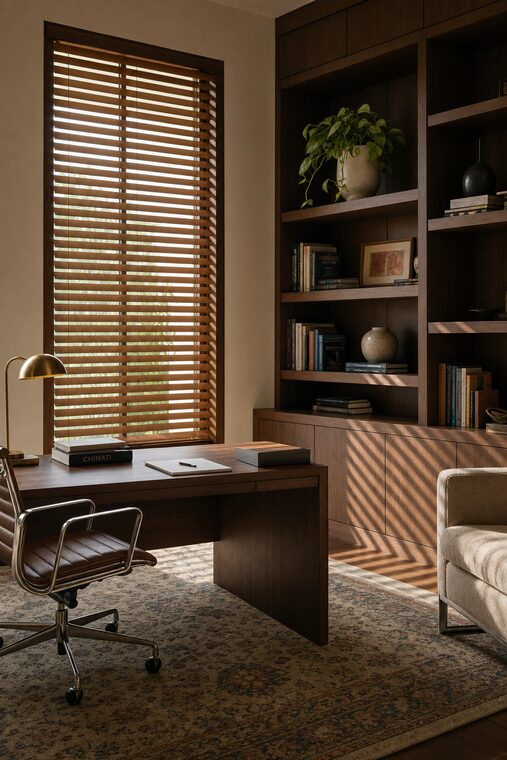


Wider slats mean fewer of them, a clearer view when open, and a more contemporary look. Narrow slats close tighter and suit a smaller or more traditional window.
Stained shows the grain and is the reason to choose real timber in the first place. Painted gives a cleaner, more architectural line. Both can be matched to joinery already in the room.
A cloth ladder tape covers the route holes, hides the cords, and adds a decorative band down the blind. Cord alone is plainer and lets more light through the holes.
A wand tilts the slats, a cord lifts them. Cordless is standard in any room a child uses, and motorized tilt is what makes a whole run sit at the same angle.
Inside the recess shows the trim and needs enough depth for the stack. Outside mount covers a poor frame, blocks more edge light, and makes a small window read larger.
Tilting the slats down puts light on the desk and keeps it off the screen, which is a thing no shade can do.
A stained timber blind brings something to a pale room that a white treatment cannot. With a blackout shade behind it, it still does the job at seven.
On a wide opening real timber is meaningfully lighter than faux wood, which shows in how it feels to use every day.
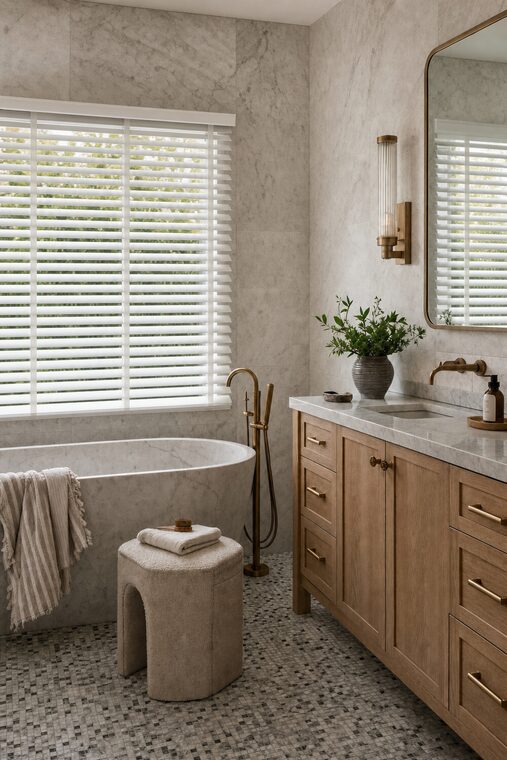
Timber moves with humidity. Over a shower, a bath, or a kitchen sink it will cup and twist eventually, and no finish stops that for long. We would rather tell you now than replace it in two years.
Faux wood and composite look the same from across the room and do not move. That is the right specification for a wet room.
All blinds2 inch suits most windows. Go to 2 1/2 inch on a main living window where you want fewer slats and a clearer view, and 1 inch on a small or period window.
No. Slats close to a line, not to black, and the route holes and edges always leak. A bedroom that needs real darkness wants a blackout shade behind the blind.
Tape hides the route holes, which is the main source of light leak through a closed blind, and it adds a decorative band. No tape is plainer and cheaper. Aesthetics mostly.
We would not specify it. Humidity makes timber cup and twist over time. Faux wood or composite gives you the same look without the movement.
Close the slats one way and wipe with a dry microfibre cloth, then close them the other way and repeat. Nothing wet on real timber.
Four rooms, two finishes, and what the slat width is doing in each.

The same look where timber should not go: bathrooms, laundries, over a sink.
See the range →
Slimmer and more precise, in slat widths down to half an inch.
See the range →
The same tilt in a framed panel, built into the opening rather than hung in it.
See the range →Book a free in-home consultation. We will bring the samples, take the measurements, and leave you with a proper quote.