Cut long, hung high, and made to the fullness the fabric actually needs — not to whatever a standard panel happens to measure.
They are too short, so the hem floats an inch above the floor and the eye goes straight to it. They are too narrow, so the panel pulls flat instead of falling in folds. And they are hung on the frame rather than near the ceiling, which makes the window look smaller than it is.
Custom drapery fixes all three before the fabric is even chosen. We measure the drop to the floor, work out the fullness that weight of cloth needs, and decide where the track goes.

An even, continuous wave with no pleat at the head. The cleanest of the lot, and the one that suits a modern room and a long run of glass.
See the range →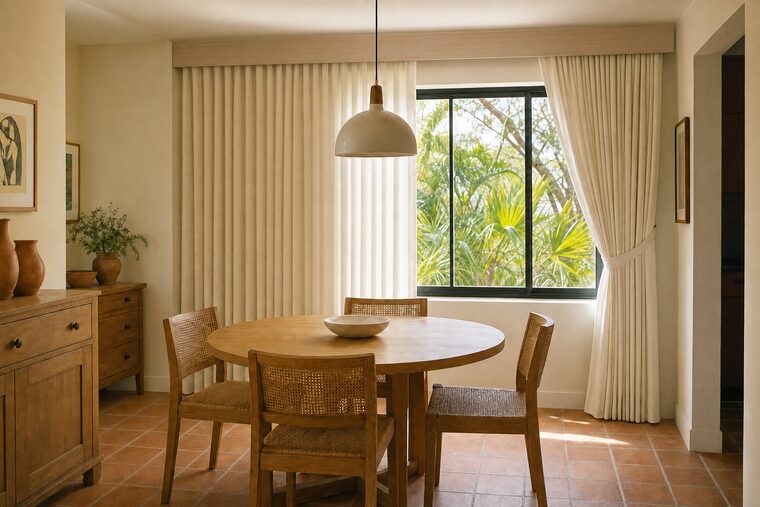
Three folds gathered at the head, the traditional workroom pleat. Holds a deep, formal fold and stacks tightly off the glass.
See the range →
Pinched at the top of the pleat rather than the middle, so the fold opens as it falls. Tailored without reading as formal.

Metal rings set straight into the heading, sliding on an exposed rod. Casual, quick to draw, and the least expensive to make.

Light through, detail gone. Hung alone on a shaded elevation, or under heavier panels so you can soften the room without closing it.
See the range →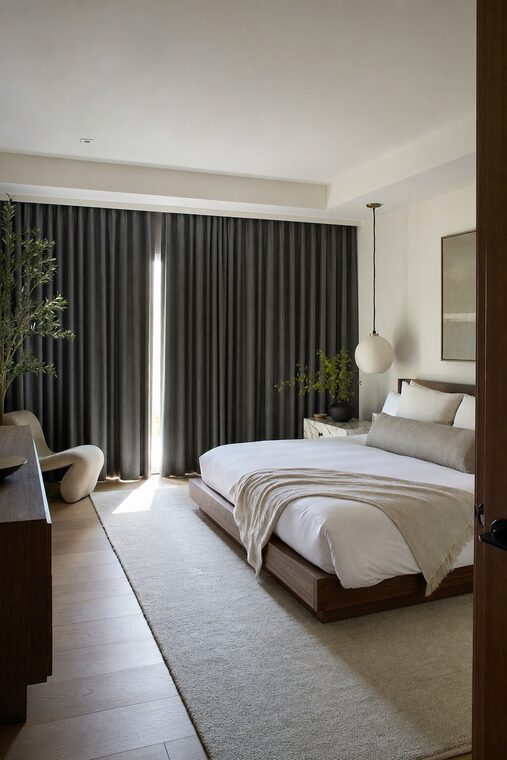
A three-pass lining sewn in behind the face fabric. The bedroom answer, and the only one that holds a room dark past six in the morning.
Drapery is measured to the floor, not to the sill. Whether it stops a quarter inch clear, kisses the floor or breaks onto it changes the whole character of the room, and it is decided at the measure.
How many times the width of the window the fabric actually is. Two times reads thin on a sheer and about right on a heavy weave. This is the single biggest difference between custom and ready-made.
Unlined lets the weave show and the light through. Lined gives body and protects the face fabric from Florida sun. Interlined adds a layer between the two for weight and a deeper fold.
A rod is part of the room and is meant to be seen. A track is meant to disappear, and is what ripple fold and anything motorized runs on. Ceiling-recessed hides it completely.
Where the fabric sits when it is open. Extending the track past the frame lets the panels clear the glass entirely, which is how you keep the view and the daylight you paid for.
Complete the window with a custom cornice: a rigid top treatment that frames the opening, conceals the track and hardware, and gives it a finished look. Clean contemporary lines or a decorative profile, in poly or driftwood, painted to match your walls or finished in white.
Linens, flax blends, woven grasses, and performance weaves that hold their color in Florida light. A designer brings the ones that suit your rooms; these are a starting point.
 Flax
Flax
 Oyster
 Bone
Bone
 Sisal
Sisal
 Fog
Fog
 Driftwood
 Clay
Clay
 Char
Char

A twelve-foot run of lined drapery is heavy, and drawing it by hand twice a day is how the leading edge gets grubby. On a track it moves on a remote, a keypad, your phone, or a schedule.
Lutron is our premium motorization option for shades and drapery tracks: quiet, precise, and made to work with the rest of the home.
About motorized draperyHigher than most people expect. We hang close to the ceiling rather than to the window frame, which draws the eye up and makes the whole wall read taller. Where there is a deep return or a recessed pocket, the track disappears into it.
Our default is a kiss, which is the hem just meeting the floor with no gap and no fold. A break looks softer and hides a floor that is out of level. A float is the practical choice where the panels are drawn constantly or there is a dog in the house.
Very often that is the right answer — a shade doing the work of light and privacy, drapery doing the work of softening the room. We design the pair together so the stack heights line up.
Any fabric fades in Florida light eventually. Lining is the main defense, and it is why we line almost everything on a south or west elevation. Performance weaves hold their color longest.
There is no honest answer to that before we have measured. Price moves with fabric, width, lining, hardware, and motorization. The consultation and the written quote are both free.
Every panel here was cut to a measured drop and made to the fullness that fabric needed.
Four steps, one team, and no surprises at the end of it.
A short conversation about the windows, the light, and how you actually use the space.
A designer visits, measures every opening precisely, and brings fabrics to see in your own light.
Fabric, lining, hardware, motorization, and installation. One number, itemized.
Our own installers fit, program, and test everything, then take the packaging away.
 Choosing
While styling matters in dressing your windows, function and comfort carry equal weight when deciding on the type of window treatment to use in a room.
 Choosing
Interior decorators will say that curtains and drapes are the finishing touches that complete a room, but are they relevant in Florida?
 Choosing
Enhancing your living space and turning it into something that fits your tastes require various renovations and modifications.
Book a free in-home consultation. We will bring the samples, take the measurements, and leave you with a proper quote.