Light through, detail gone. The softest thing you can put on a window, and the layer that makes everything else look considered.
A sheer is not there to cover the window. Drawn across the glass it takes the hard edge off Florida light, hides the view of the neighbor's roof, and leaves the brightness intact. The room stays light and stops being glary.
Hung on its own it suits a shaded elevation. Layered under heavier panels it gives you a daytime setting and a night-time one from the same window.


Linen sheer has texture and a slub, and it is the one that looks like a made thing rather than a product. Voile is smoother and more uniform. A heavier open weave holds a wave better on a track.
Sheers need more fullness than solids, not less. At 2x a sheer looks thin and mean. 2.5x is the minimum we specify and 3x is where they start to look properly generous.
Under heavier panels on a double track is the classic arrangement: sheer for the day, solid for the night. On its own where privacy is not an issue and the light simply needs softening.
Ripple fold suits sheers particularly well because the continuous wave reads beautifully in a translucent cloth. Pinch pleat works on a rod where the hardware is part of the look.
A sheer shows every fault in a hem line because light passes through it. We cut these to kiss the floor, and anything uneven in the floor gets dealt with at the measure.
Drawn across a bright wall they cut the hard light and keep the room feeling open, which no solid treatment does.
Sheer closed and drapery open through the day, both closed at night. It is the arrangement most people actually want and few specify.
On a north wall or a courtyard nobody overlooks, a sheer on its own is all the window needs.
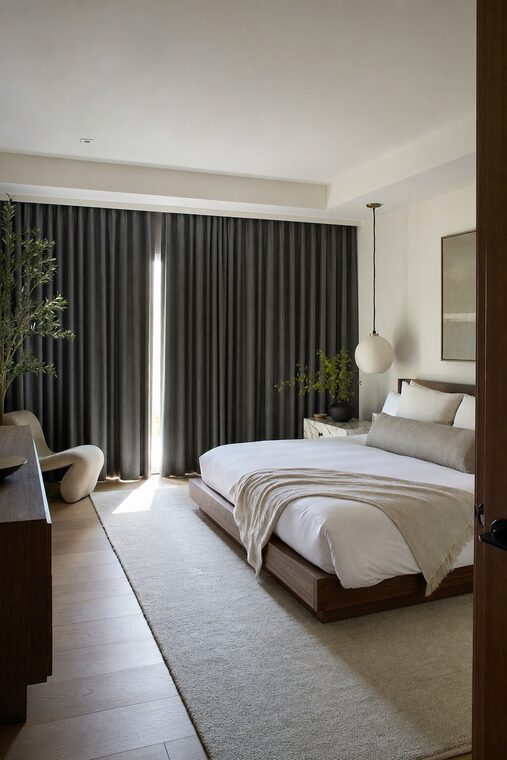
A sheer works by being brighter outside than in. Once the sun goes down and the lamps come on, that flips: you can be seen and you cannot see out. Nothing is wrong with the fabric, that is simply how translucency works.
Which is why in a bedroom or a street-facing room we specify a second layer from the start.
About lined draperyIn daylight, yes, a good deal. After dark with lights on inside, none. If a room needs night privacy the sheer wants a lined panel or a shade behind it.
More than solids. 2.5x is our minimum and 3x looks best. A sheer at 2x reads as a flat panel of fabric rather than a curtain.
Sheers take the most direct light of any treatment because they are the layer nearest the glass. On a west wall we would specify a performance sheer, which holds color far longer than a natural one.
Some can, most should be professionally cleaned. Linen sheers shrink and lose their hang in a domestic machine. We mark which yours is on the paperwork.
Sheer plus a roller shade is the most practical and takes the least wall. Sheer plus drapery is the better looking of the two. Both work; it comes down to the room.
Four rooms, and the difference between a sheer alone and a sheer layered.

The heading sheers look best in, because the wave carries through a translucent cloth.
See the range →
The lined panel that hangs outside the sheer and does the night-time work.
See the range →
A harder-working filter for the same problem, where the glare is severe.
See the range →Book a free in-home consultation. We will bring the samples, take the measurements, and leave you with a proper quote.