Folds gathered and stitched at the head, the traditional workroom heading. Deep folds, a tight stack, and hardware you are meant to see.
Fabric is gathered into a group at the top and hand-stitched so the fold holds its shape permanently, then repeated at a fixed spacing across the width. It is the oldest heading there is and still the one that hangs best.
Because the fullness is concentrated at the pleat rather than spread evenly, the folds are deeper and the panel stacks tighter when it is drawn back. On a window where wall space is short, that matters.

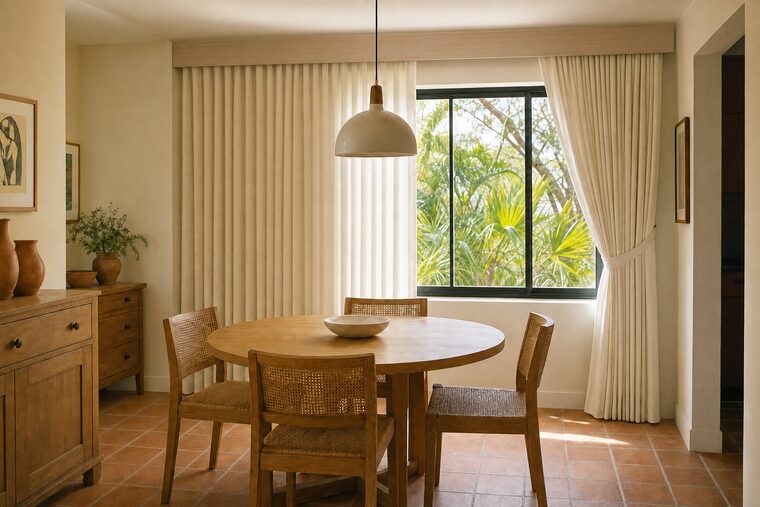

Three finger is the classic and the default. Two finger is neater and uses less cloth. Goblet is rounded and formal and wants a tall window. Euro pinches at the top of the pleat so it opens as it falls.
How many times the width of the window the flat fabric is. 2x reads thin on a sheer and acceptable on a heavy weave. 2.5x is our usual specification. 3x is full and the folds are noticeably deeper.
Unlined shows the weave and lets light through. Lined adds body and protects the face cloth from Florida sun. Interlined puts a soft layer between the two for weight and a deeper fold. Blackout for bedrooms.
This heading takes a decorative rod, which is part of the room and meant to be looked at. It also runs on a track where you want the hardware to disappear.
Measured to the floor, not the sill. A kiss just meets it, a break lets the hem fold slightly and hides an uneven floor, a puddle is deliberate excess. Decided at the measure.
In a room with moldings, a mantel, and good trim, a heading with visible craft in it belongs. Ripple fold would read as too quiet.
The fullness sits in the pleat rather than spread across the run, so a drawn panel takes up less wall than ripple fold of the same fullness.
Blackened steel, unlacquered brass, or timber. This is the only heading where the pole is part of the design rather than something to hide.
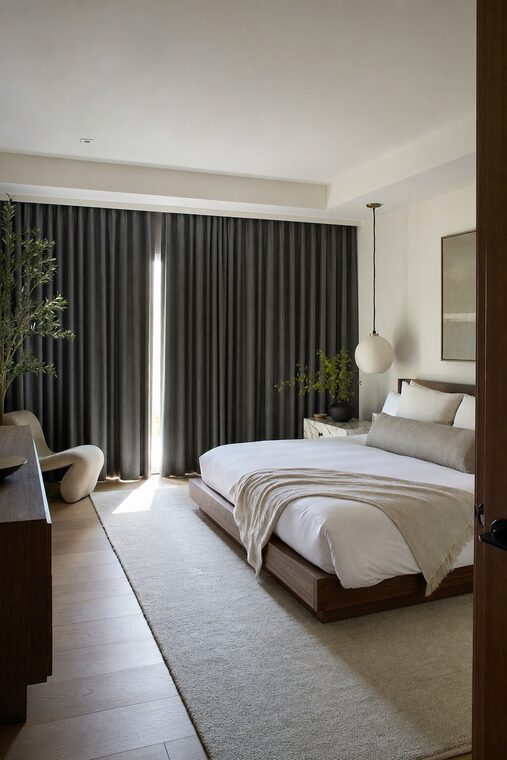
The lining decides how a pleat holds, how the panel hangs, and how long the face fabric survives a west-facing wall. Interlining adds a soft layer between face and lining, and it is the difference between drapery that falls and drapery that hangs.
It is also the least visible thing on the quote, which is exactly why it is the first thing cut elsewhere.
All draperyThree, unless there is a reason not to. Two finger suits a lighter cloth and a smaller window. Goblet needs height to look right and is a deliberately formal choice.
Rod where you want the hardware seen and the window is a feature. Track where the drapery should appear to come from the ceiling, or where the run is long enough that a rod would sag.
2.5x for most fabrics. Go to 3x on a sheer or where you want visibly deep folds, and 2x only on a heavy weave and a tight budget. Below 2x it stops looking custom.
Yes, because they are stitched rather than clipped. A hand-finished pleat keeps its shape for the life of the drapery, which is not true of a ready-made tape heading.
On a track, yes, and it is worth it on a long or heavy run. A decorative rod with rings is a hand-draw treatment.
Three rooms, three fullnesses, and what the lining is doing in each.

One continuous wave with no pleat at the head. Quieter, and better over a long run.
See the range →
Hung under a pinch pleat panel, or alone where the light is already soft.
See the range →
The same fabric language inside the opening, where a full drapery treatment would be too much.
See the range →Book a free in-home consultation. We will bring the samples, take the measurements, and leave you with a proper quote.