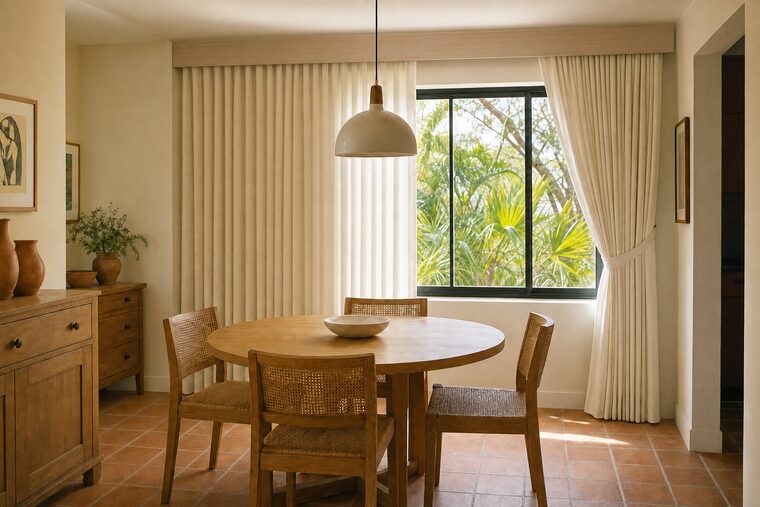
An even, continuous wave with no pleat at the head. The cleanest way to hang fabric, and the one long runs of glass were waiting for.
Every other heading gathers the fabric into groups: three folds pinched together, then a flat gap, then three more. Ripple fold does not gather at all. Carriers spaced evenly along a track hold the cloth in a single continuous S, from one end of the run to the other.
On a short window that is a subtle difference. On twenty feet of sliding door it is the whole design, because nothing interrupts the rhythm.


Ripple fold is specified as a percentage rather than a multiplier. 80 percent is a shallow, modern wave. 120 percent is deep and luxurious and uses considerably more cloth. 100 percent is the usual answer.
This heading only exists on a track; there is no rod version. Ceiling mounted is the standard, and a recessed pocket in the plaster hides the hardware completely so the fabric appears from nothing.
Wants a cloth with enough weight to hold a curve. Linens, linen blends, and heavier sheers all work. A stiff fabric will not wave and a very fine one has nothing to hold the shape.
Split draw parts in the middle; one-way draw stacks it all to one end, which is what a corner or a single door needs. Extending the track past the glass lets the stack clear the opening entirely.
A long run of lined cloth is heavy and the leading edge is what gets handled. On anything over about ten feet a motor is worth it for the fabric as much as the convenience.
The heading has no repeat to break, so a twenty-foot run reads as one continuous wave instead of a series of groups.
There is no pinch, no goblet, and no visible hardware if it is recessed. In a room with no moldings it is the heading that does not argue.
On a track with a one-way draw the whole panel clears the doorway, which a rod and rings will never do as tidily.
Pinch pleat is the traditional workroom heading: gathered in threes, deeper folds, and it stacks tighter off the glass. It suits a room with moldings and a decorative rod.
Ripple fold is quieter and more contemporary, and it is the better answer on a very long run. Neither is more expensive by definition; the fullness and the fabric decide that.
About pinch pleatNo. The heading is created by carriers running in a track at fixed spacing, so a track is not a preference here, it is a requirement.
Less than a pinch pleat of the same fullness, but it still needs somewhere to go. We extend the track past the opening wherever the wall allows it so the glass stays clear.
Yes. Track can be bent to a bay or returned around a corner, and the wave carries through the curve without a break, which a rod cannot do.
Very well, and a sheer ripple fold across a whole wall is one of the nicest things we hang. It wants a heavier sheer than you would use on a rod so the wave holds.
Not inherently. The cost is in the fullness, the fabric, and the length of track. A 100 percent ripple fold and a 2.5x pinch pleat in the same cloth land in a similar place.
Three rooms, and what the heading does over distance.

The traditional workroom heading. Deeper folds, tighter stack, and it takes a decorative rod.
See the range →
Light through, detail gone. Hung alone, or under heavier panels.
See the range →
The working layer behind drapery: privacy and glare, without the yardage.
See the range →Book a free in-home consultation. We will bring the samples, take the measurements, and leave you with a proper quote.