Panels on the bottom half of the window only. Privacy exactly where you are sitting, and the sky left completely alone.
Most windows have a problem in the bottom half and none at all in the top. Somebody can see in at eye level; nobody can see in at head height. A full-height treatment solves both and costs you the daylight for the privilege.
Cafe style solves only the half that needs solving. The frame stops at the transom or wherever you decide, and everything above it stays open glass.


Usually at a transom bar or a glazing bar, because the eye reads an existing line as deliberate. Where there is no line to work to we set the height against the furniture and the sightline from the street.
The same three widths as a full shutter, but the panel is short, so a very wide louver can look out of proportion. On most cafe panels 2 1/2 or 3 1/2 inch sits better than 4 1/2.
A cafe panel needs a frame on three sides and a clean top edge. Getting that top edge right is most of the work, because there is nothing above it to hide behind.
Hardwood where the room is dry, waterproof composite anywhere near a sink or a bath. A short panel is light, so weight is rarely the deciding factor here.
Painted to match the trim is the usual answer, because a cafe panel sits in the middle of the window where it reads against the frame rather than against the wall.
You are sitting down, so the sightline is low. Covering the bottom half deals with it and leaves the room as bright as it was.
On a ground floor window near a path, everything that needs blocking is below chest height. There is no reason to lose the rest.
On a tall Georgian-style opening, a full shutter can swamp it. Stopping at the transom keeps the vertical proportion the window was designed with.
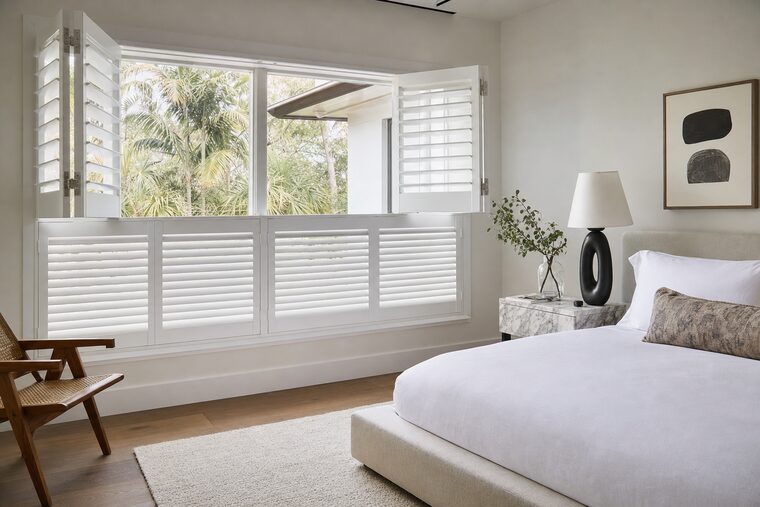
Cafe style leaves the top of the window as bare glass, permanently. Tier on tier puts shutters over the whole opening but splits them into two independent sets, so the top can be opened or closed as you like.
Cafe is cheaper and lighter in the room. Tier on tier costs more and gives you the option of closing the whole thing at night.
All shuttersTo an existing horizontal line on the window if there is one. Failing that, high enough to break the sightline from wherever people actually walk past, which we work out standing in the room.
Sometimes, but the frames rarely match perfectly and the join usually shows. If you think you might want the whole window covered eventually, tier on tier from the start is the better decision.
Only below the panel line. With lights on, anything above it is visible from outside. In a room where that matters we would specify tier on tier or a shade above.
Not if the top edge is right. A cafe panel that stops at a transom reads as deliberate; one that stops at an arbitrary height on a plain window can look unresolved, which is why we set that line on site.
Usually, because there is roughly half the panel. The frame work is the same though, so it is not half the price.
Two rooms where only the bottom half was ever the problem.

The full-height version, covering the whole opening in one run of panels.
See the range →
For a wide slider, where the panels need to concertina back and clear the doorway.
See the range →
A softer way to cover part of a window, in fabric rather than framed joinery.
See the range →Book a free in-home consultation. We will bring the samples, take the measurements, and leave you with a proper quote.