Tilt is the thing a blind does that a shade cannot, and it is the thing nobody gets right by hand. A motor sets the angle and every blind in the run holds it.
A shade goes up and it goes down. A blind also tilts, and the tilt is where most of the light control actually lives — a louver angled fifteen degrees down kills the glare on a screen while leaving the room bright.
Done by hand that angle is a guess, and on a bank of four windows it is four different guesses. A motor sets it once, to the degree, and repeats it across the whole run every time.


Two inch wood is the warm one and the one that suits a living room. Faux wood takes the same slat into a bathroom or a kitchen without moving. Aluminum goes down to half an inch, which is what you want when the blind should read as part of the architecture rather than the furniture.
Tilt-only is the cheaper motor and covers most of what people actually do with a blind day to day. Tilt and lift does both, and is the one to specify on a window somebody would otherwise have to reach across furniture to raise.
Rechargeable motors drop into an existing window with no wiring and run about a year between charges on a tilt-only blind. Hardwired never needs charging and is quieter, and it is the right call on a wide run or anything high up.
Blinds on the same wall are set as one group so a single press moves all of them together and holds them level. Groups can overlap — one for the bank of four, one for the whole room, one for the floor.
A wall keypad is what gets used, because it sits where a light switch sits. Schedules do the rest: tilt down when the sun comes round to the west, level again at six.
The tilt that kills the reflection on a monitor is a narrow one, and finding it by hand every morning is a nuisance. Set it once, put it on a schedule, and the room is simply usable.
A window above head height is the clearest case there is. Motorized it works; unmotorized it is decoration, left at whatever angle the installer chose.
A motorized blind has no cord and no chain, which removes the hazard entirely rather than tying it up out of the way. It is the reason most nurseries we fit end up cordless.
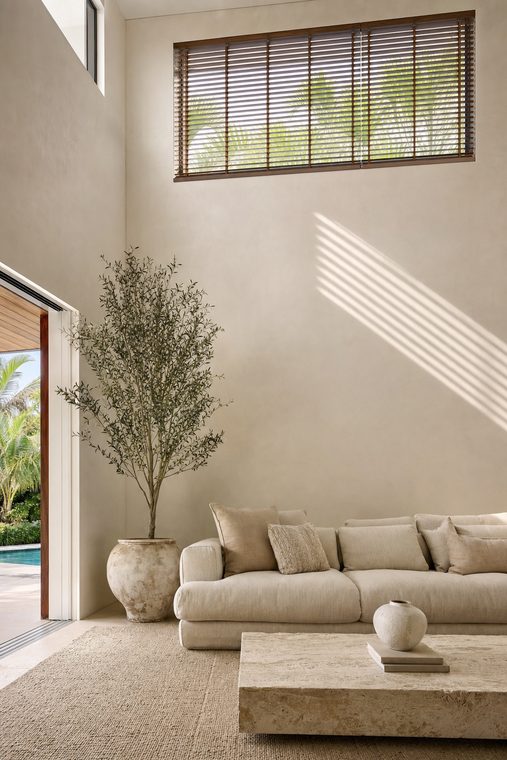
Clerestory glass, a window over a stairwell, anything above a run of cabinetry — these get fitted and then never touched again, because touching them means fetching a ladder.
A motor is what turns that window back into something that works. It is also, usually, the window doing the most damage: high glass takes the midday sun straight onto the floor and the furniture.
How motorization worksUsually not well. The tilt mechanism and the headrail have to be built for a motor, so in practice this is a new blind in the same opening rather than a conversion. The slat and the finish can be matched exactly.
Tilt only for most windows, because tilting is what people do with a blind. Tilt and lift where the window is high, wide, or behind something you would have to climb over.
Around a year on a tilt-only blind cycled normally, less on tilt and lift, and less again on a wide heavy blind. Charging is a cable at the headrail, twenty minutes once a year.
Yes, that is most of the point. Blinds set as a group are driven together and stop at the same angle, which is the thing that is almost impossible to hold by hand across four windows.
A tilt motor runs for two or three seconds and is quieter than a lift motor because it is moving almost nothing. In a study with the door open you would not hear it from the next room.
Five rooms in Palm Beach County, every one cordless.

Where most people start, and the fastest way to fix a west-facing room.
See the range →
On a recessed ceiling track, and the treatment that gains the most from a motor.
See the range →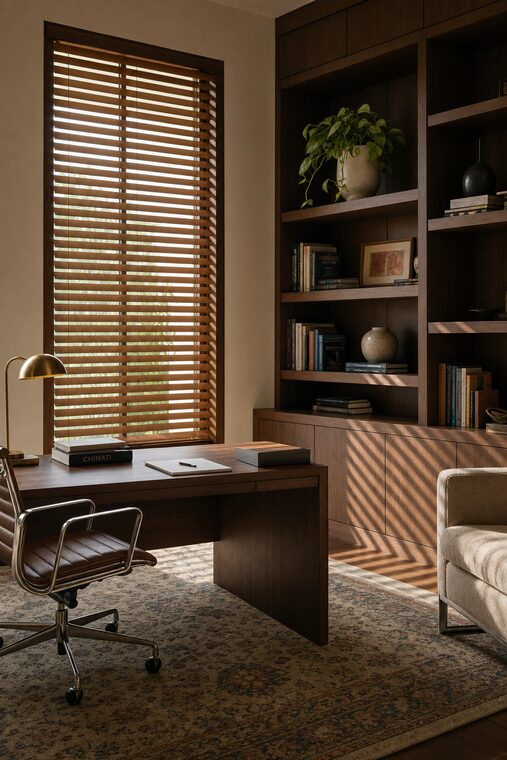
The slats, the stains, and the widths, before you decide about the motor.
See the range →Book a free in-home consultation. We will bring the samples, take the measurements, and leave you with a proper quote.