Grasses, reeds, and bamboo woven into a panel. The only treatment we sell where the material is the decoration.
Every other shade on this site is a manufactured surface. A woven wood is a natural one: reeds, grasses, jute, and split bamboo woven together, so no two panels are quite the same and the light coming through it is broken rather than diffused.
That is what it is for. In a room of flat paint and plain upholstery it supplies the texture the scheme was missing, which is why designers reach for it long before they reach for a pattern.


The single biggest decision. A tight flat weave reads tailored and lets very little light through. An open reed or split bamboo is loose, casts a speckled light, and shows the material clearly.
Unlined is the honest version and lets the weave glow, but it gives almost no privacy. A privacy liner sits behind the weave and keeps the texture from the room side. A blackout liner makes it a bedroom treatment.
A flat fold rolls up cleanly against the head. A waterfall keeps a continuous curve with no hard creases, which suits a looser weave and a taller window.
A cloth edge band frames the panel and hides the cut ends of the weave. It can match, contrast, or be left off entirely where you want the raw edge.
Cordless as standard in any room a child uses. Natural weaves are heavier than they look, so on a wide or tall opening a motor is worth having.
An open reed weave turns hard Florida sun into a speckle across the floor. It is the treatment that suits a room made mostly of glass.
Where everything is flat paint, linen, and pale timber, a natural weave supplies interest without introducing a color or a pattern to commit to.
The same role a roller plays, but with material you can see. Behind an open drapery panel it gives the window depth.
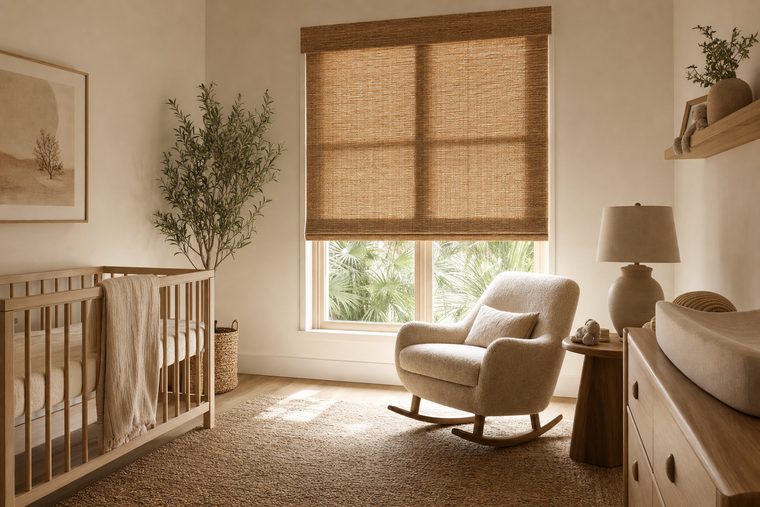
A natural weave is full of gaps, because that is the point. Unlined, it filters the light beautifully in the day and gives you almost nothing after dark, when the lamps go on and the room lights up from inside.
In a bedroom or a street-facing room we always specify a liner. We would rather say that now than at the installation.
All shadesNot exactly, and that is the nature of it. These are natural fibers, so panels vary slightly between batches and mellow over time. We order a whole room together so they age as a set.
Only with a liner. The weave itself always has gaps. A privacy liner keeps the texture visible from inside while closing the shade up, and blackout goes further still.
Natural fibers lighten in strong sun over the years, more so on a south or west window. A liner slows it considerably by taking the direct light off the weave.
Not really. Humidity makes natural weaves swell and go slack over time. A faux woven-wood look in a performance fabric is the better answer over a bath.
Vacuum along the weave with a brush head. Nothing wet, and no cleaning products. Dust does not show on them anything like as much as it does on a flat shade.
Three rooms where the weave is doing the decorating.

The same softness in cloth rather than reed, and easier to make properly dark.
See the range →
An engineered open weave instead of a natural one, rated by openness factor.
See the range →
A woven wood under an open drapery panel is one of the best pairings we do.
See the range →Book a free in-home consultation. We will bring the samples, take the measurements, and leave you with a proper quote.